.png)
Debt Collection Compliance in 2026: Navigating the State Patchwork
For most of the last decade, debt collection compliance had a single center of gravity: the Consumer Financial Protection Bureau (CFPB) in Washington. Learn the federal rulebook — the Fair Debt Collection Practices Act (FDCPA) and its Regulation F implementation — and you understood most of what governed how you could contact a consumer about a past-due balance.
In 2026, that center of gravity has moved. Federal oversight has contracted sharply, and states are stepping into the gap with their own laws, licensing rules, and enforcement muscle. For any team recovering overdue accounts in-house, the practical challenge has changed: compliance is no longer one rulebook, but fifty. Here's what's shifting, and how to keep your recovery process on the right side of it.
The federal referee has stepped back
The CFPB has dramatically reduced its footprint. Under the current administration, the Bureau has dismissed numerous pending enforcement actions, withdrawn or rescinded dozens of guidance documents, and moved to cut its workforce to a fraction of its former size (Credit and Collection News). A high-profile example: the CFPB's January 2025 rule to remove medical debt from consumer credit reports was vacated by a federal court in July 2025, which found the rule exceeded the Bureau's authority under the Fair Credit Reporting Act (Consumer Finance Monitor).
It would be a mistake to read this as "less regulation." The FDCPA and Regulation F are still federal law and still fully in force. What's changed is who is watching — and increasingly, that's the states.
States are writing the new rulebook
State attorneys general and financial regulators have moved into the federal vacuum, and they have clear legal authority to do it. Section 1042 of the Dodd-Frank Act lets state AGs directly enforce federal consumer financial laws — including the FDCPA — without waiting for the CFPB. On top of that, nearly every state has its own Unfair, Deceptive, or Abusive Acts and Practices (UDAAP) statute, many of which are being expanded to match or exceed federal scope (Credit and Collection News).
The result is a genuine patchwork, and it varies in ways that matter operationally:
- Licensing. Most states require collection agencies to hold an active license, and collecting without one can render the debt unenforceable. California requires licensing under the DFPI, Illinois through its Department of Financial and Professional Regulation, and Florida through the Office of Financial Regulation (MSB).
- Communication limits. Some states now cap contact frequency below Regulation F's federal baseline, and layer on their own rules for calls, texts, and emails.
- Privacy overlays. In states like California, the CCPA/CPRA adds data-handling obligations on top of collection-specific rules.
Medical debt: the clearest example of the shift
Nowhere is the federal-to-state handoff more visible than in medical debt. With the CFPB's national rule vacated, states have taken the lead. In 2025 alone, six states — Delaware, Maine, Maryland, Oregon, Vermont, and Washington — enacted laws restricting medical debt on credit reports, and roughly 15 states now have some form of medical-debt credit-reporting protection (Commonwealth Fund).
The rules go beyond credit reporting. Maine now requires hospitals to offer payment plans that cap monthly payments at 4% of income for lower-income patients, and Maryland has prohibited lawsuits over medical bills of $500 or less (Commonwealth Fund). Nevada and Texas condition hospital credit reporting on meeting price-transparency and estimate requirements. If you recover healthcare receivables across state lines, "compliant" now depends heavily on where the patient lives.
What still holds everywhere: FDCPA and Regulation F
State variation sits on top of a federal floor that hasn't gone anywhere. Regulation F (12 CFR Part 1006) remains the baseline for consumer-facing collections (eCFR), and a few of its core provisions are worth re-checking against your own workflow:
- The seven-in-seven call rule. No more than seven call attempts per debt in a seven-day period, and a seven-day pause after connecting with the consumer.
- Opt-out on electronic channels. Every email and text used for collection must offer a clear, conspicuous way to opt out of that channel (CFPB).
- Reasonable procedures and documentation. Reg F expects collectors to maintain procedures reasonably designed to avoid contacting consumers at inconvenient times or through channels they've asked you to stop using — and to be able to show it.
That last point is the connective tissue between federal and state compliance. Whether an AG in your state is enforcing the FDCPA or its own UDAAP statute, the question is the same: can you demonstrate what you did, when, and with what consent?
What this means for in-house AR teams
If you're recovering overdue balances internally rather than handing them to an agency, the state patchwork is manageable — but only if your process is built for it. A few priorities for 2026:
- Map your states. Know where your consumers are and which licensing, contact-frequency, and industry-specific rules apply in each. Treat a multi-state receivables portfolio as a multi-rule portfolio.
- Make consent and opt-outs auditable. Capture how and when a consumer agreed to be contacted, honor opt-outs instantly across channels, and keep a durable record. Verbal assurances won't help you in an enforcement review.
- Log every interaction. A time-stamped trail of messages, payments, and status changes is your best defense if a contact is ever challenged — and it's exactly what state regulators increasingly expect.
- Lean on self-service. Letting consumers view balances, set up plans, and pay on their own terms reduces the volume of outbound contacts you have to make — which lowers both compliance risk and friction.
Turn compliance into an operating advantage
The teams that will thrive in a state-by-state world are the ones whose systems make good behavior the default: consent captured automatically, opt-outs honored instantly, every touchpoint documented, and consumers given an easy way to resolve balances themselves.
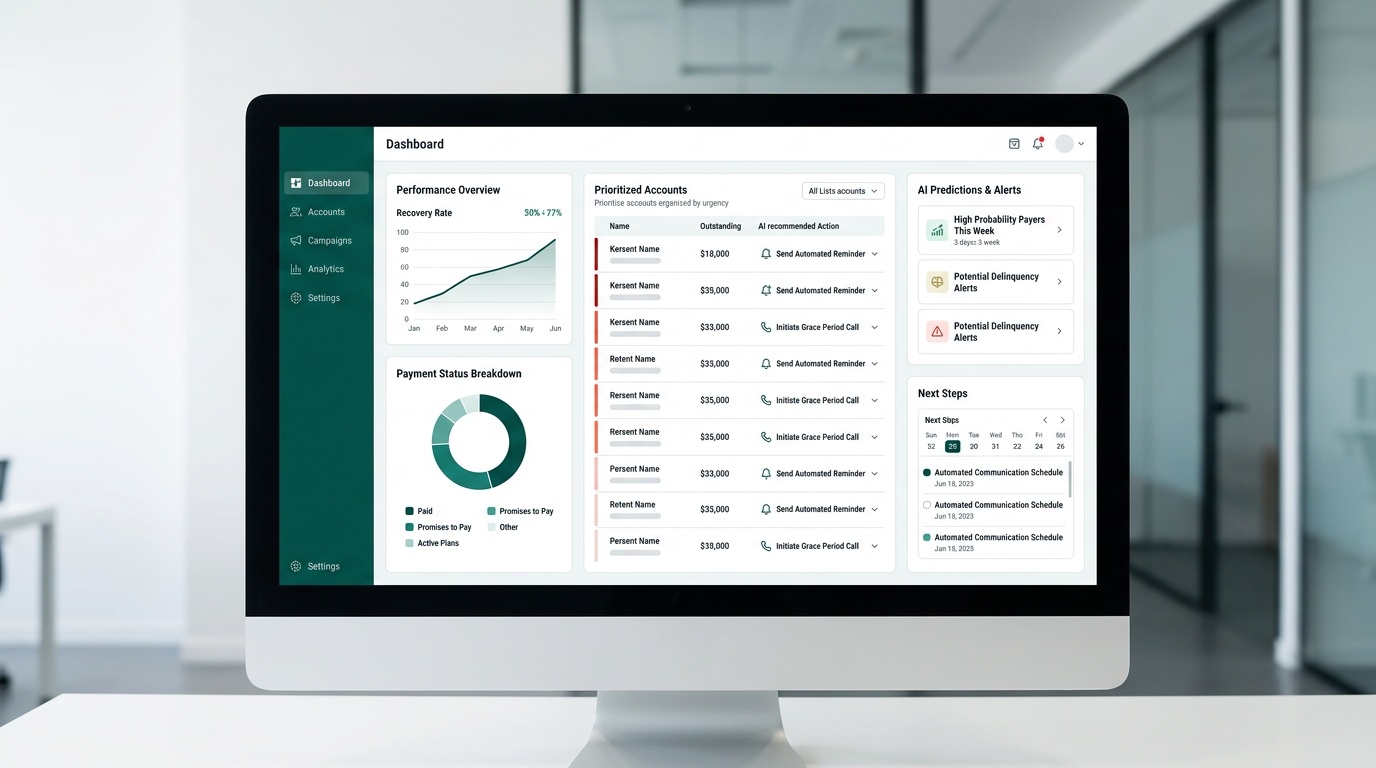
That's the idea behind Dash. Dash is built for organizations managing overdue A/R in-house, with automated text and email outreach designed around TCPA and FDCPA requirements, SOC 2 Type 2-audited data handling, and self-service payment tools that keep consumers in control. Real-time dashboards give you a documented view of every interaction, payment, and status change — the audit trail that today's fragmented compliance landscape rewards.
Federal oversight may be quieter in 2026, but the expectations on how you treat consumers are anything but. See how Dash helps you recover more while staying compliant — without adding headcount or handing your accounts to a third party.
This article is for general informational purposes and is not legal advice. Debt collection laws vary by state and change frequently; consult qualified counsel about your specific obligations.