.png)
ach payment meaning
Every business that sends payroll, collects recurring payments, or recovers overdue balances is likely already touching the ACH network -- even if they don't think of it in those terms. Understanding the ACH payment meaning isn't just trivia for finance teams. It's foundational knowledge for anyone who wants to move money efficiently, reduce transaction costs, and build payment workflows that actually scale.
Key Takeaways
- The ACH network is a core system for common business transactions like payroll, recurring payments, and debt recovery.
- Understanding ACH payment meaning helps businesses move money with greater efficiency.
- Utilizing ACH payments can significantly reduce transaction costs for organizations.
- Knowledge of ACH allows businesses to develop payment workflows that scale effectively.
ACH transfers power some of the most common financial transactions in the U.S.: direct deposit, mortgage payments, subscription billing, and electronic invoice payments. Yet many business owners and operations teams don't fully understand how the network works, where delays come from, or how ACH fits into a modern receivables strategy.
This guide breaks down exactly what ACH payments are, how they process, where they outperform alternatives like wire transfers, and how platforms like Dash connect ACH to automated outreach for overdue account recovery. Whether you're setting up your first ACH debit or rethinking how you collect past-due balances, you'll leave with a clear picture of how this network works -- and how to put it to work for your business.
Key Takeaways
- ACH stands for Automated Clearing House, an electronic network that moves funds between bank accounts across U.S. financial institutions.
- ACH payments process in batches, typically settling within one to three business days, with same-day options available for eligible transactions.
- Businesses use ACH for payroll, recurring billing, and overdue account recovery -- reducing cost and friction compared to paper checks or wire transfers.
- Platforms like Dash connect ACH to automated outreach and self-service payment options to accelerate recovery without third-party agencies.
Table of Contents
- Unpacking the ACH Payment Meaning
- How ACH Payments Work
- ACH Use Cases and Advantages
- ACH and Modern Collection Strategies
- Frequently Asked Questions
Unpacking the ACH Payment Meaning
Quick Answer: An ACH payment is an electronic bank-to-bank transfer processed through the Automated Clearing House network, used for direct deposits, bill payments, and business transactions -- no cash, checks, or card networks required.
ACH payments move money between bank accounts using routing and account numbers. The network is governed by Nacha, which sets the operating rules for standardized transfers across U.S. financial institutions. No card brands, no intermediary processors -- just direct bank-to-bank movement through a shared, regulated infrastructure.
Two transaction types run the network. ACH credits push funds from the originator to the recipient -- payroll direct deposit is the clearest example. ACH debits pull funds from a customer's account with prior authorization, which is how most recurring bill payments work. That distinction matters when you're building payment workflows: getting the authorization model right up front prevents returns, disputes, and delays down the line.
For teams managing overdue accounts, the ACH debit structure is especially useful. Once a customer authorizes a payment -- whether on a portal, by phone, or through a signed agreement -- you can run that payment electronically without chasing a check. That's a meaningful operational shift. See how Dash structures authorization and settlement flows for first-party receivables recovery.
How ACH Payments Work
ACH transactions move through batch processing. Rather than sending funds one-by-one in real time, the network groups transactions and processes them in scheduled cycles throughout the business day. An Originating Depository Financial Institution (ODFI) submits batches to an ACH operator -- either the Federal Reserve or The Clearing House -- which routes each entry to the Receiving Depository Financial Institution (RDFI).
Standard ACH payment processing time runs one to three business days. Same-day ACH can settle eligible transactions within the same business day when files are submitted before cutoff times. Weekends and federal holidays pause processing entirely, so any timeline calculation needs to account for non-processing days. A payment initiated Friday afternoon, for instance, may not settle until Tuesday.
The table below compares ACH against wire transfers -- the other common bank-to-bank option -- so you can match the right method to each payment scenario.
| Transfer Type | Processing Time | Cost | Best For |
|---|---|---|---|
| Standard ACH | 1-3 business days | Low (often cents per transaction) | Recurring payments, payroll, high-volume billing |
| Same-Day ACH | Same business day | Higher fee than standard ACH | Time-sensitive transfers within the U.S. |
| Wire Transfer | Same day (when sent before bank cutoff times) | Often $15-$50 per transfer | Large, one-time transactions where speed is non-negotiable |
For high-volume receivables -- think dozens or hundreds of payments per month -- ACH's per-transaction cost advantage compounds quickly. A wire at $25 per transfer becomes expensive fast. ACH keeps that cost near zero, which is why it's the default for payroll processors, subscription platforms, and software-enabled collections.
ACH Use Cases and Advantages
ACH payments support a wide range of business transactions: payroll, vendor payments, subscription billing, insurance premiums, and mortgage payments. For overdue balances specifically, ACH debits cut through the friction of paper checks -- once a customer provides authorization, payments can run on a one-time or scheduled basis without requiring follow-up on every cycle. See how Dash structures this for overdue account recovery.
What makes ACH particularly well-suited for receivables work is the combination of low cost and repeatability. You're not paying card interchange on every transaction, and you're not manually initiating wires. Authorization is captured once; the payment runs automatically from there. For businesses managing dozens of payment plans simultaneously, that difference is significant.
That said, ACH isn't the right tool in every situation. Here's a clear-eyed look at where it performs well and where it falls short.
✅ Pros
- Lower cost per transaction than most wire and card payment options
- Supports both one-time and recurring payment structures
- Enables automation once customer authorization is in place
- Widely accepted across U.S. banks and credit unions
❌ Cons
- Settlement typically takes one to three business days -- not instant
- Returns can occur due to insufficient funds or incorrect account details
- Debit entries require prior customer authorization, which must be properly documented
- Doesn't work for international transfers -- ACH is a U.S.-only network
ACH and Modern Collection Strategies
Overdue accounts don't resolve themselves. The question is how you reach customers, present payment options, and make it easy for them to follow through. ACH fits naturally into that sequence: when a customer can authorize a one-time or installment payment electronically -- without a phone call, a mailed check, or a trip to a payment portal -- the friction that kills recovery rates drops significantly.
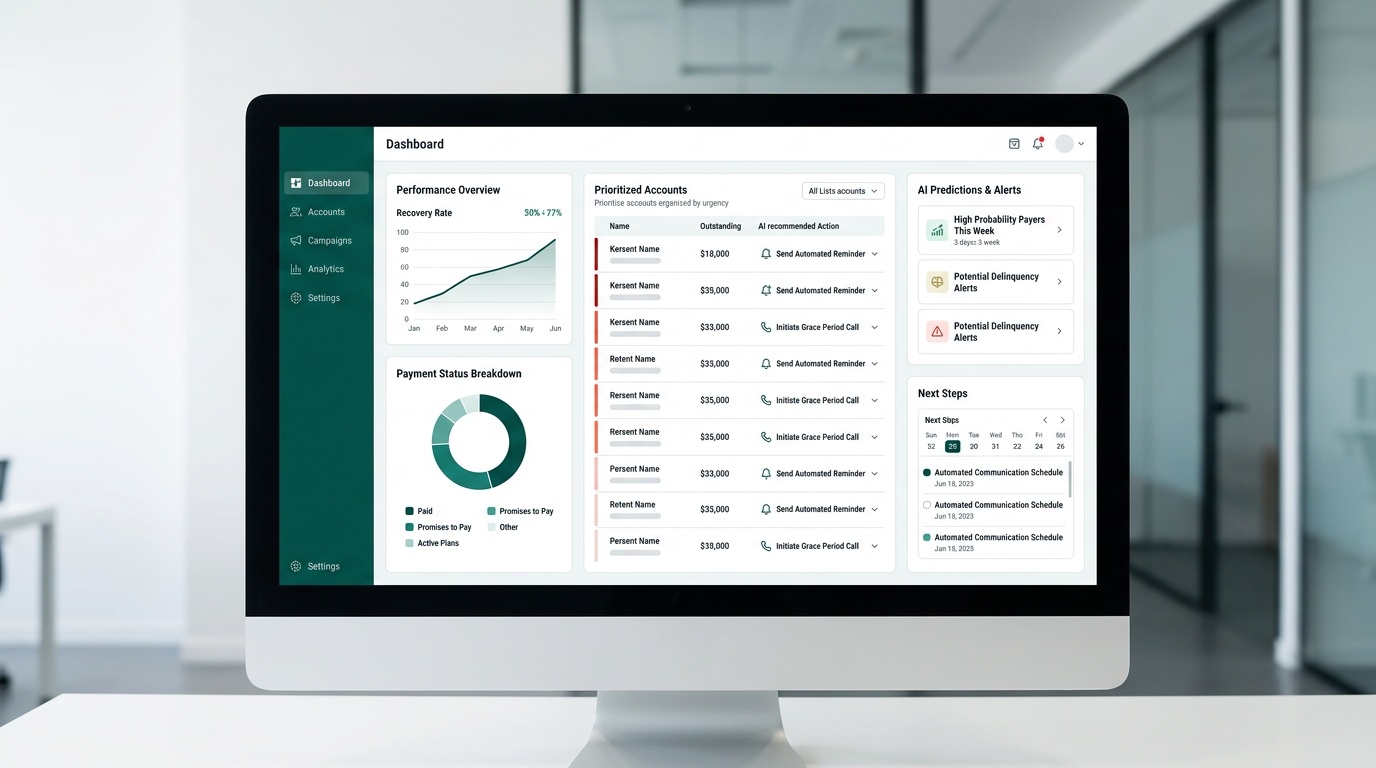
Dash is built around exactly this model. The platform supports automated text and email outreach for overdue accounts, routing customers to secure self-service payment options where they can authorize a payment or set up a plan on their own terms. Dash meets PCI Data Security Standards and is designed to support compliance with TCPA and FDCPA requirements -- so your outreach operates within regulatory guardrails, not around them.
One question that comes up often: what does an ACH entry look like on a bank statement? Typically, customers see a descriptor tied to the merchant, employer, lender, or payment platform that originated the transfer -- something like "ACH DEBIT -- [COMPANY NAME]." If a customer calls to question a charge, that descriptor is usually enough to trace it back to the originator. Having clean authorization records on your end makes resolving those inquiries fast.
On security: ACH has strong authorization requirements and a defined dispute resolution process governed by Nacha's rules. That doesn't mean teams can skip the basics -- verifying authorization before initiating a debit and protecting account data are non-negotiable. But for businesses worried about whether ACH is safe, the short answer is yes, provided the authorization process is handled correctly on both ends.
Frequently Asked Questions
How do I pay someone via ACH?
To pay someone via ACH, you need their bank account number and routing number, along with their authorization for the transfer. From there, you can initiate either a one-time payment or set up a recurring debit, depending on the agreement. The funds move electronically through the ACH network from your bank account to theirs, typically settling within one to three business days.
What is the difference between direct deposit and ACH payment?
Direct deposit is a specific type of ACH payment -- technically an ACH credit, where funds are pushed into the recipient's account. ACH payments are the broader category, covering both credits and debits. While direct deposit typically refers to payroll being deposited into an employee's account, ACH debits work the other direction: funds are pulled from a customer's account for bill payments, loan repayments, or authorized collections.
Is Zelle an ACH payment?
Zelle is not an ACH payment. Both move money between bank accounts, but Zelle operates on a real-time payment network designed for immediate transfers between enrolled users. ACH payments are processed in scheduled batches and typically settle within one to three business days, though same-day ACH options are available. The speed and use cases differ meaningfully between the two.
Is ACH only in the US?
Yes, the ACH network is specific to the United States. It's governed by Nacha, which sets operating rules for electronic transfers across U.S. financial institutions. If you need to send funds internationally, you'll need a different mechanism -- such as SWIFT wire transfers or cross-border payment platforms. Other countries operate their own equivalent networks with different rules and timelines.
Do ACH transfers go through immediately?
No, standard ACH transfers are not immediate. Transactions are batched and processed at scheduled intervals during the business day, with standard settlement taking one to three business days. Same-day ACH can process eligible transactions within the same business day if submitted before the applicable cutoff time, but even that isn't instant in the way a Zelle or Venmo transfer might feel to the end user.