.png)
The Hidden Revenue Leak in Healthcare
Every year, U.S. healthcare providers write off billions of dollars in uncollected patient balances — not because the money isn't owed, but because the follow-up process breaks down. Billing errors, denied claims, and aging AR reports that never get worked are quietly draining the revenue of medical practices, urgent care centers, and hospital systems alike.
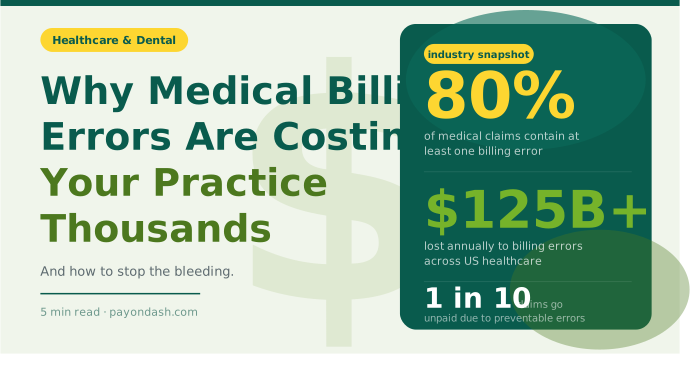
The American Medical Association estimates that nearly $125 billion in claims go uncollected annually. Behind that number are real practices — ERs, specialty clinics, dental offices — leaving money on the table that could fund staff, equipment, and better patient care.
Where Medical Billing Goes Wrong
Medical billing is complex by design. Between ICD-10 codes, insurance verification, prior authorizations, and ever-shifting payer rules, there are dozens of failure points in any revenue cycle. The most common culprits include:
- Incorrect patient information — wrong insurance ID, outdated address, or missing date of birth can kick a claim back instantly.
- Coding errors — upcoding, undercoding, or mismatched procedure and diagnosis codes trigger automatic denials.
- Timely filing violations — claims submitted outside a payer's filing window are denied outright, with little recourse.
- Lack of follow-up — aging AR balances pile up when billing teams are stretched thin and manual outreach falls through the cracks.
For many practices, the issue isn't that claims are never submitted — it's that denied and unpaid claims don't get worked aggressively enough. Staff bandwidth, outdated systems, and sheer volume mean that a large percentage of recoverable revenue simply ages out.
The Real Cost of Aging Accounts Receivable
A common industry benchmark: the older a balance gets, the harder it is to collect. Balances under 30 days have a collection rate near 90%. By the time they hit 90 days, that rate drops to around 70%. Past 120 days, you're often looking at 50% or less — and many practices eventually write these off entirely.
For a mid-sized urgent care group seeing 200 patients per day, even a 5% improvement in AR recovery can mean hundreds of thousands of dollars per year in additional revenue. Multiply that across multiple locations, and the numbers become significant fast.
How AI Is Changing Medical AR Recovery
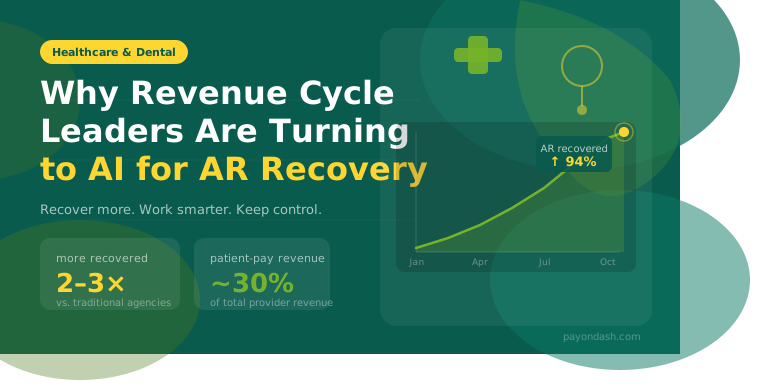
Traditional accounts receivable recovery relied on manual follow-up calls, mailed statements, and third-party collection agencies that often damaged patient relationships and charged steep fees. Today, AI-powered platforms are rewriting that playbook.
Dash is built specifically for this problem. By combining automated patient outreach with intelligent payment workflows, Dash helps healthcare organizations recover past-due balances without the friction of traditional collections. There are no threatening letters, no third-party handoffs, and no damage to the patient relationship that practices work so hard to build.
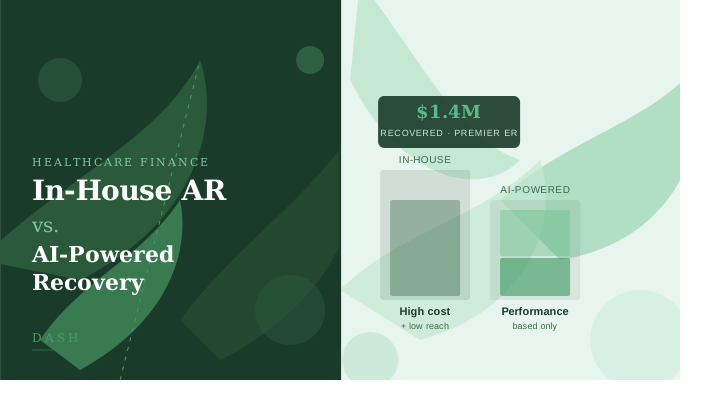
The results speak for themselves. Premier ER & Urgent Care, a multi-location emergency care provider, has recovered over $1.4 million in patient balances through Dash since 2023 — balances that would otherwise have aged out or required costly collection efforts.
What to Look for in an AR Recovery Partner
If your practice is evaluating tools to address aging receivables, here are the questions worth asking:
- Does it integrate with your existing practice management software? Friction in implementation slows adoption and ROI.
- How does it handle patient communication? Tone matters. Patients who feel respected are far more likely to pay.
- What does the reporting look like? You should be able to see exactly which balances were contacted, what was recovered, and where the gaps remain.
- What are the fees? Some platforms charge a percentage of recovered balances. Others operate on a SaaS model. Make sure the economics make sense for your volume.
The Bottom Line
Medical billing will always be complex — that's unlikely to change. But the tools available to manage that complexity are evolving rapidly. Practices that invest in smarter AR recovery today will be better positioned to protect their revenue, support their teams, and ultimately deliver better care.
If your practice is sitting on aging receivables, the question isn't whether to act — it's how fast you can start recovering what you're owed.
Dash helps healthcare organizations automate accounts receivable recovery with AI-powered patient outreach. To see how it works for your practice, visit payondash.com.