.png)
The Assumption That's Costing Healthcare Orgs Millions
Most healthcare organizations assume that managing accounts receivable in-house is cheaper than outsourcing or adopting an AI-powered recovery platform. It feels intuitive — you're already paying your billing team, you have the EHR system, and the process is "working." But when CFOs and revenue cycle leaders actually run the numbers, a different picture emerges.
The real question isn't whether your AR process is functioning. It's whether it's recovering everything it could — and at what cost per dollar collected.
What In-House AR Actually Costs
The visible costs of an in-house AR operation are easy to identify: staff salaries, benefits, training, and software licenses. But the hidden costs are where the gap widens:
- Aging AR write-offs — Industry data consistently shows that balances unpaid past 90 days have a dramatically lower recovery rate. For balances past 120 days, you may recover less than half. Every day a balance sits unworked is lost revenue.
- Staff turnover and training — Billing and collections staff turnover is notoriously high in healthcare. Each departure means onboarding costs, productivity dips, and accounts that fall through the cracks during the transition.
- Volume limits — An in-house team can only work so many accounts per day. AI doesn't have this ceiling. It can simultaneously manage thousands of accounts, triggering the right outreach at the right moment based on behavioral signals — without adding headcount.
- Compliance exposure — HIPAA, TCPA, and FDCPA compliance require constant vigilance. A single non-compliant communication can result in significant fines. In-house teams rely on training and policies; AI-powered platforms bake compliance into every touchpoint by design.
- Opportunity cost — Every hour your billing team spends chasing aging balances is an hour not spent on claim submissions, denial management, or process improvements that prevent AR problems upstream.
What AI-Powered Recovery Actually Costs
This is where many healthcare finance leaders have outdated assumptions. The perception of AI-powered AR tools is often: expensive, complex to implement, and risky to hand off patient data to. The reality in 2025 is the opposite.
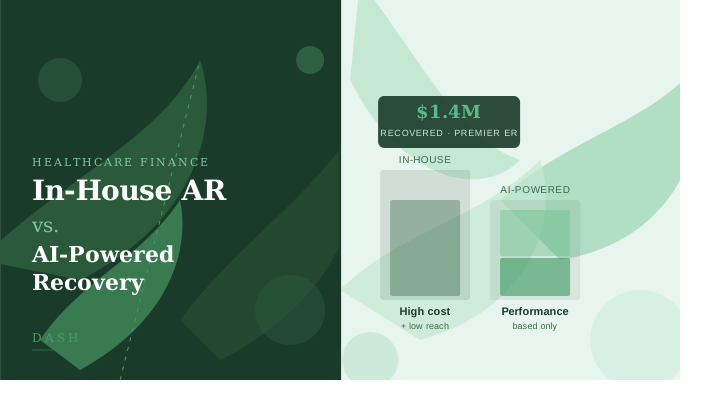
Platforms like Dash operate on a performance-based model — meaning you pay only when balances are successfully recovered. There's no upfront licensing fee eating into your budget before you've seen a single dollar returned. Implementation is measured in days, not months. And compliance certifications — HIPAA, SOC 2 Type 2, PCI DSS, TCPA, FDCPA — are built in, not bolted on.
The math becomes straightforward: if Dash costs a percentage of what it recovers, and it recovers accounts your in-house team wouldn't have gotten to, the net result is additional revenue you didn't have before — at no additional overhead.
A Real-World Benchmark
Premier ER & Urgent Care, a multi-location emergency and urgent care group, has recovered over $1.4 million in patient balances through Dash since September 2023. That includes a growth trajectory from a modest pilot in late 2023 to over $669,000 recovered in 2024 alone — a volume their internal billing team wasn't positioned to work through standard AR processes.
The key wasn't replacing their billing team. It was extending their reach into the aging AR segment that was previously being written off — and doing it at a cost tied entirely to results.
The Right Framework for the Decision
If you're evaluating whether to expand your in-house AR capacity or adopt an AI-powered recovery platform, the right framework has three questions:
- What is your current cost per dollar collected? Add up fully-loaded staff costs, software, and overhead — then divide by your annual collections from AR activities. Most organizations are surprised how high this number is.
- What's your aging AR write-off rate? Look at balances over 90, 120, and 180 days. What percentage is being recovered versus written off? That gap is your opportunity.
- What would you do with recovered revenue? This isn't just a collections question — it's a strategic one. Recovered AR is often the highest-margin revenue a healthcare organization can generate, since the service has already been delivered and the cost is already sunk.
The Bottom Line
AI-powered AR recovery isn't a replacement for strong revenue cycle management — it's the extension that makes your existing team more effective without adding cost. For healthcare organizations carrying significant aging AR, the question isn't whether an AI platform can deliver ROI. It's how much recoverable revenue is being left on the table right now.
Dash works on a performance basis. That means the risk of trying it is essentially zero — and the cost of not trying it is every balance that ages out before your team gets to it.
Want to see what Dash would recover for your organization? Book a 15-minute demo and we'll walk through your AR profile together.